


For years, James Merrill hesitated to leave his job as a software engineer. “Great side hustle," his colleagues would say when he mentioned his art. “It somehow offended me, because I always felt that my art was my actual career and my job was a side hustle.”
During that time, he had already gained a reputation in the generative art space for “ORI," a series of 3D animations that he sold on the NFT platform Art Blocks. However, it still didn’t convince him to go all in on his art practice. Even seeing his digital art flickering across the billboards in Times Square didn’t change his mind. Then he became a father.
“I asked myself if, one day, my daughter came to me for advice whether she should stay in a comfortable but unfulfilling career or pursue her art practice, I would tell her to be an artist. And if I didn't do that myself, I'd be a hypocrite.” That’s why, in 2022, he finally quit his job — and hasn’t regretted it since.
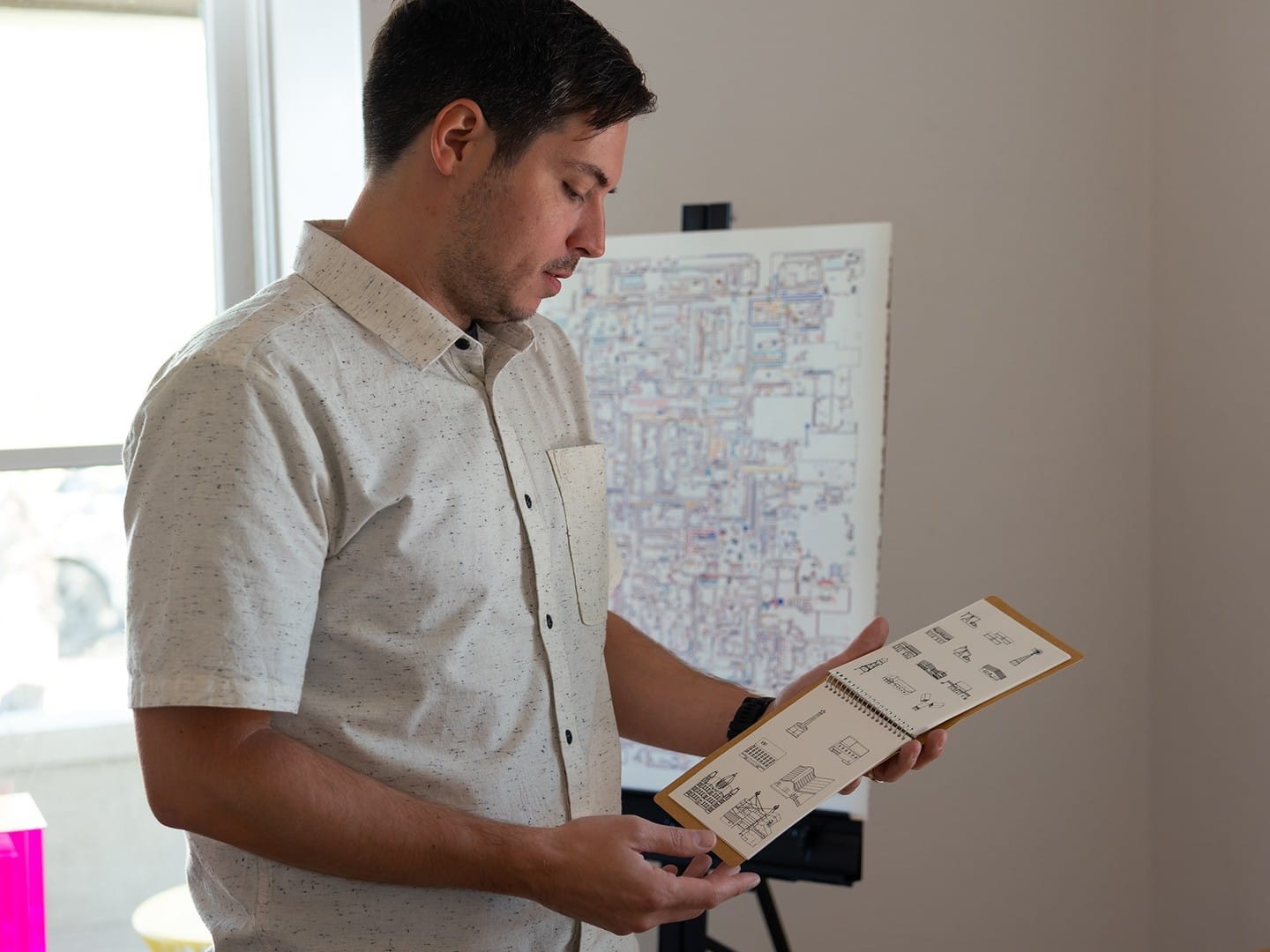
Merrill’s practice is multidisciplinary. He uses generative code to create animations, interactive art installations, static images and, his specialty, physical plotter drawings. He first learned about pen plotters in 2019, while browsing Hacker News, where a fellow digital artist demonstrated how easy it was to set up the drawing machines, without needing custom hardware programming.
The low barrier to entry persuaded Merrill to buy an AxiDraw A3 for $600. “At the time, this was a huge investment for me. I decided that if I sold $600 worth of art on Etsy, I would call it a success.” And it worked. A few weeks later, he sold six plotter drawings for $135 apiece.
The History of Pen Plotter Art: From Georg Nees to Vera Molnár
Merrill follows in the footsteps of a lineage of artists who date back to the 1960s. At the time, pen plotters relieved architects of the burden of drawing blueprints and circuit diagrams. And it was only a matter of time before artists such as Georg Nees, Frieder Nake and Vera Molnar experimented with pen plotters to create the first computer-based algorithmic creations that we today call generative art.
Before discovering plotter art, Merrill’s main tools had been a keyboard, a mouse, and a screen. Today it's mostly ink, paper and fountain pens. With this, he creates digital-physical hybrids that combine the unpredictability of generative code with a tangible piece of fine art on paper.
“I’m really outside of the domain of knowing the results because there's all this improbability, all this texture and real-world chaos in the creation of the art that makes the final result really surprising,” he explains. “You could run out of ink or someone might bump your table or the power might go out. Generative art plus plotters add a new dimension. When things go wrong, sometimes the effects are beautiful in their own way.”
James Merrill talking about BUSY, his latest collection of plotter drawings available on Art Blocks.
700 Hours and 7 Miles of Ink to Create 50 Plotter Drawings
Choosing the right paper, ink and pens for plotter art is a science in itself. To create BUSY, Merrill’s latest edition of 50 multicolor plotter drawings, it took 700 hours of draw-time and 7 miles of line work for just one color of ink. If he would try to realize ambitious projects like those with a normal pencil or pen, the abrasion of the paper would wear down the drawing utensil.
“To prevent that, I knew I needed a metal nib and archival ink”, he says. So he chose fountain pens because they keep drawing for hundreds, even thousands of hours, without wearing out. Another advantage is that the ink can be refilled and is archival. Some varieties even shift color as the light hits the page.
“When you're applying multiple colors in a drawing, and the pen is out of position because you took it out and put it back in with a different color, then your alignment is off. So registration with pen-plotted work is really tricky,” he explains. “I had to devise a whole solution with fountain pens to accomplish that. And the trick with them is you need to hold them at a 45 degree angle. Over the course of 50 drawings and 700 hours of work, it's now pretty much bulletproof.”
Merrill’s inspiration for Busy stems from the overwhelm he experienced while visiting New York for the first time after spending the pandemic in rural Vermont. But then he noticed there was order in the chaos: the subway is on time, people go to work and come home, there are all these systems at play.
“That realization made me feel a lot more centered exploring cities. I knew I just needed to get used to it again.” Busy is an encapsulation of that transition. He wanted to express that feeling through generative art because it allowed him to re-create the high density and complexity of cities on paper that would be almost impossible for humans to draw by hand. “I wanted to make cityscapes and was able to do a lot of illustrations of different cities and places and incorporate them into the artwork as well,” he explains.
What excites Merrill most about plotter art is how versatile the medium is. For example, he is currently experimenting with charcoal and graphite instead of ink. The challenge is that colored pencils wear down quickly so he has to sharpen them continuously. “What if you could automate this process? That's what I'm trying to figure out right now,” he adds.
“Generative Art is Incredibly Malleable”
When asked about the future of generative art, he says that it has unique properties that separate it from any other art form. “One of them is that you can create animation at infinite scale, and raster-style graphics that feel like vectors because it’s a math-based art form. You can make art that’s incredibly malleable — whether it's the size of a building or a postage stamp," he says.
The application of the art form also allows you to manifest it in many different types of media – from plotter drawings to sculptures or even furniture. It’s digital art that doesn't have to live on screens and can exist in all these different forms, including on the blockchain, which is a big catalyst for the adoption of generative art. It’s very collectible and has great provenance because you can see exactly when things were made and how they were transacted.
I think there will certainly be a line in the sand of when generative AI became ubiquitous in our lives. Knowing there was code art created prior to that time is important because it’s pre-AI code, and we can know that with certainty because of the blockchain and its provenance. For what it’s worth, we don’t yet know exactly what that line in the sand means, but we know it exists.”


