


When Leo Castañeda was four, his parents took him to the home of a family friend. The man showed them around. Kitchen, check. Living Room, check. Bathroom, check. Bedrooms, check. It seemed like a perfectly ordinary house, except that, to Castañeda, something was missing. At the end of the tour, he looked up at the host. "But sir," he asked, "where's your studio?"
His parents still tell the story to this day. Castañeda had good reason to be confused. He grew up in Cali, Colombia, in a family where nearly every adult seemed to pursue a creative pastime. His parents are both architects, but that is only part of what they do. His mother draws fashion designs. His father paints. His grandmother, María Thereza Negreiros, is a known Surrealist painter whose studio doubled as a gathering place for artists in the city.
"Most of the adults I knew when I was little made art," Castañeda told The Overview. "I thought it was just something that everyone did." One of the people around his grandmother's studio was Hernando Tejada, the Colombian sculptor, who had befriended Negreiros after she moved from Brazil to Colombia. "He showed my grandmother the ropes," Castañeda said. "I see him as my unofficial godfather."
Tejada made sculptures that didn't necessarily behave like sculptures. Some could be handled or physically activated, hybrids of bodies and objects that invited people to interact with them. Castañeda remembers them well. "He was more of a folk Surrealist, and he influenced me a lot in terms of interactive sculpture," he said.
Castañeda didn't grow up thinking of any of this as an art education. Latin American Surrealism and abstraction weren't things he first encountered on a museum field trip. They were in his grandmother's studio, at home, in conversations with the adults around him. Art was less a category than something people did on a daily basis.
Today, Castañeda makes work that can be difficult to put into a category either. There are sculptures, video games, performances, paintings and digital environments, often parts of the same work. He builds landscapes in Unreal Engine, the software used to make many blockbuster video games, but fills them with imagery he paints himself. His games are meant to be played, though they don't always behave the way games are supposed to.
In one of them, for instance, attacking the boss is the quickest way to lose. The boss can be a waterfall, a mountain range or a cloud. It is really the landscape itself, a sentient presence governed by a system Castañeda calls "exponential reciprocity." Attack it and it responds with overwhelming force. You are dead almost immediately. The trick is to figure out what it wants.
You can sit. You can observe. You can listen. Elsewhere in the game, players calm turbulence through touch or use an ability called "deep listening." A cloud can be made solid enough to walk across.
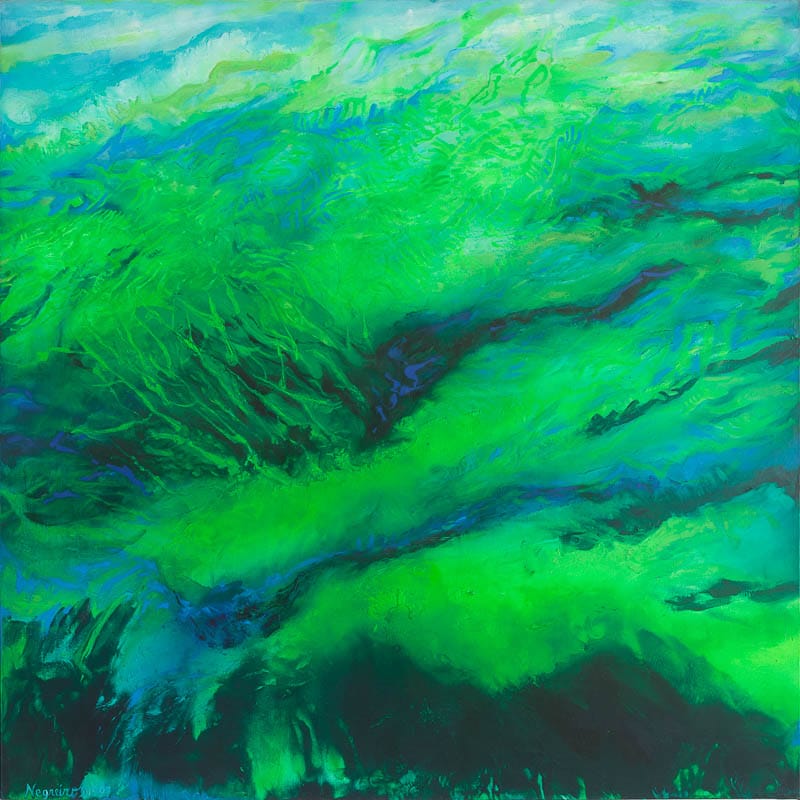
The landscapes themselves come from somewhere closer to home. Many are based on abstract paintings of the Amazon rainforest by his grandmother Negreiros. Last year, at 96, she almost died. She spent two weeks in a hospital in Cali. Castañeda came to see her every day. And he brought his laptop.
Through the hospital window, one could see the Farallones mountains in the distance. On the tray over Negreiros's bed were a coffee cup, a blue pencil and a sketchbook open to drawings of hills and a jaguar. Beside them was Castañeda's computer, running Unreal Engine.
An IV was taped to one of Negreiros's hands. Hospital bands circled her wrist. She drew and talked. She told Castañeda about growing up in Maués, in the Brazilian Amazon, and about Indigenous stories and images she remembered from childhood. He tried to work out how they might live inside the game.
At one point, she told him about guaraná, an Amazonian fruit that splits open when ripe. Its black seed sits inside white flesh, giving it the appearance of an eyeball. Castañeda put that in the game, too.
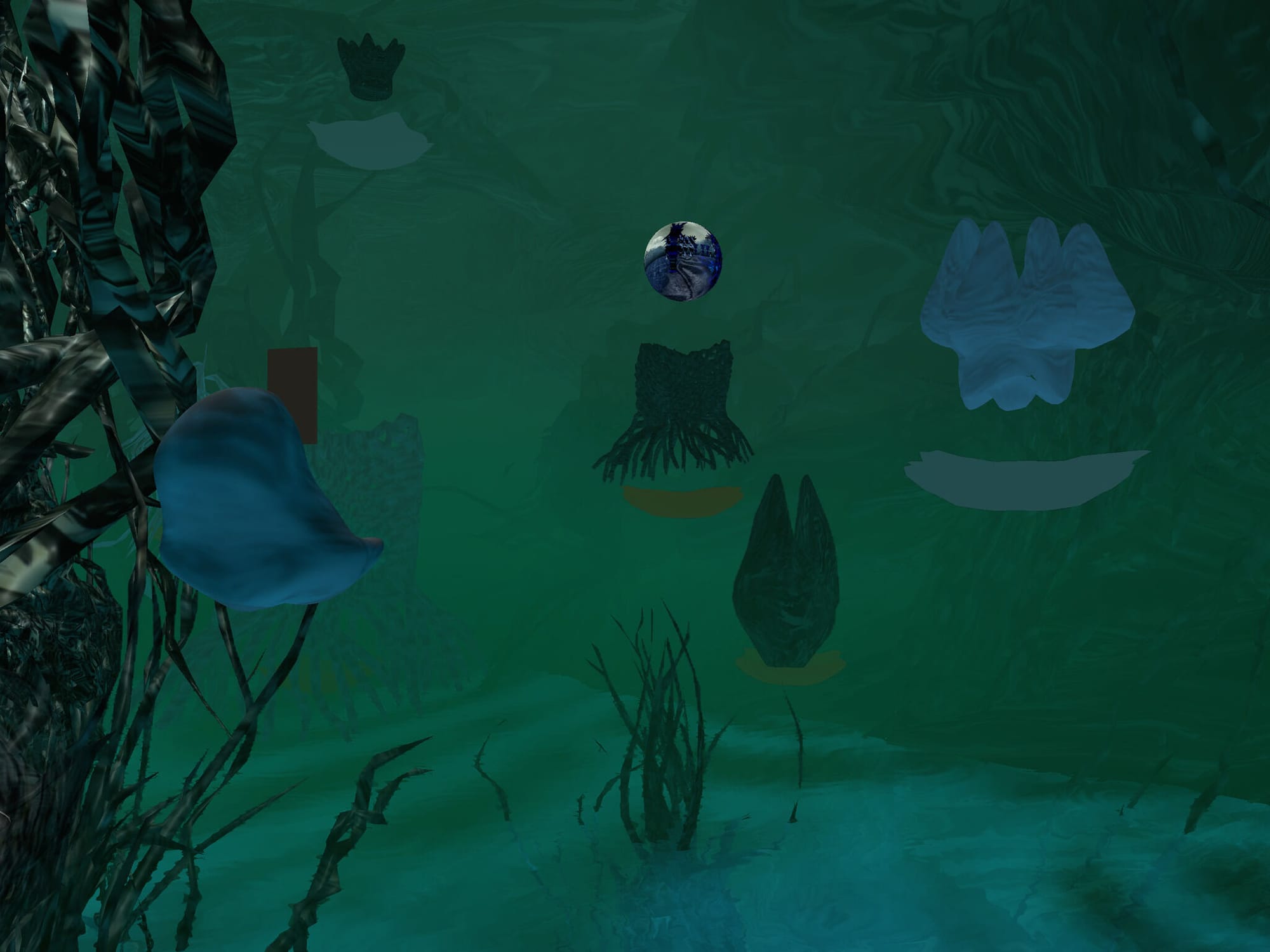
Players collect eye-like spheres of energy and deposit them as they move through the landscape. Castañeda has sometimes been uneasy about borrowing so directly from his grandmother's visual world. He worried that her work, which had surrounded him for most of his life, might simply swallow his own. "I was wary of it as me appropriating her style," he said, "or her visual identity overpowering mine."
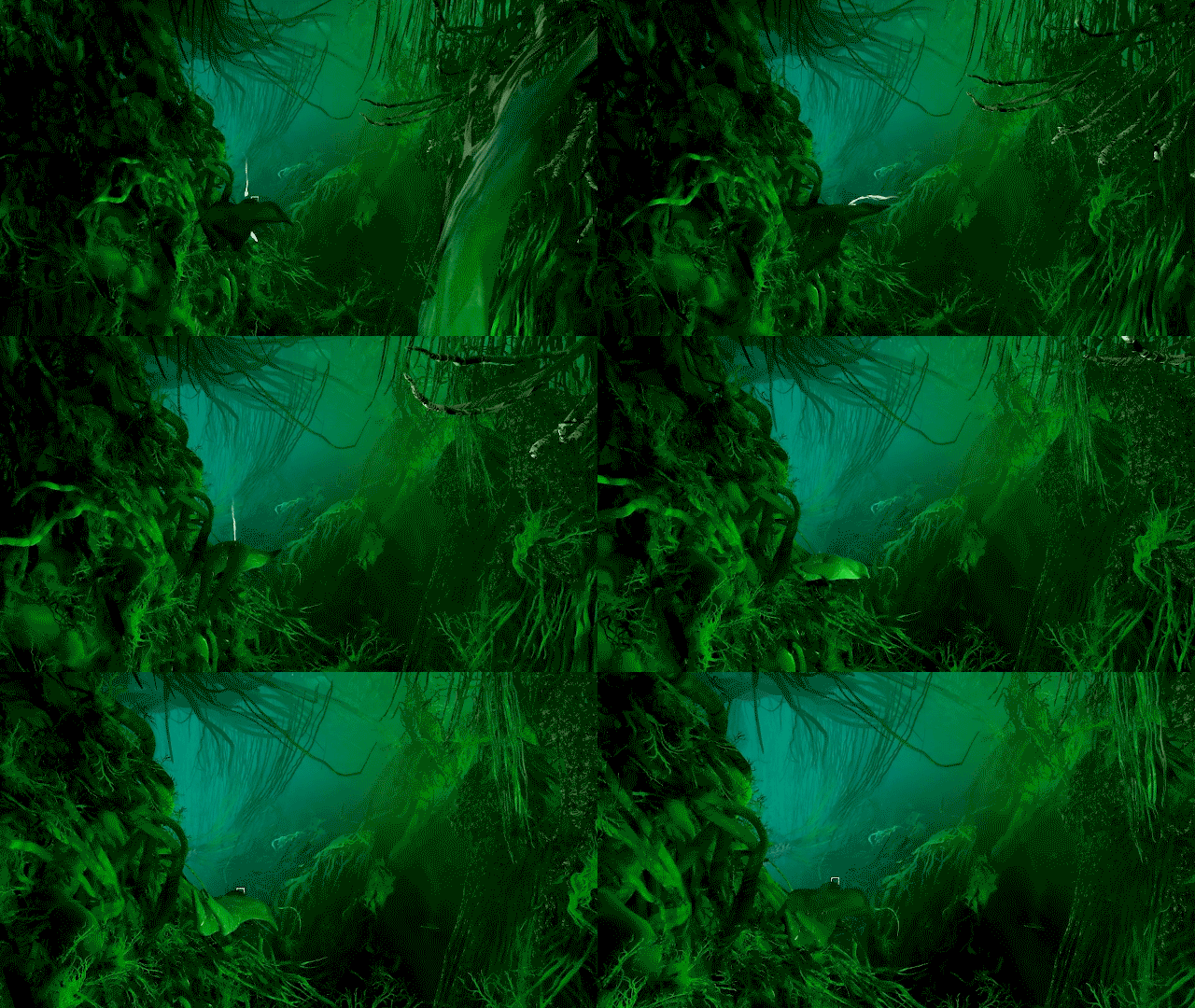
But as they continued working, it became harder to separate one person's contribution from the other's. Negreiros supplied paintings, memories and stories. Castañeda turned them into textures and environments and worked out the peculiar rules by which those environments would behave. "It became something that's both of us," he said. "A cross-generational exchange."
There was another unlikely part of the arrangement: Castañeda had largely taught himself how to make video games. "YouTube University," he calls it.
He took a Udemy course on Unreal Engine and spent years figuring out the rest. A Knight Foundation grant eventually gave him enough financial room to step away from the teaching role he had taken on to make a living and spend more time on his own work. A few months after the conversations in the hospital, Camoflux: Levels and Bosses appeared in the Whitney Biennial.
At the Whitney, Castañeda's various influences came together in one artwork. There were Tejada's lessons about sculpture as something to touch and participate in, the video games Castañeda had taught himself to build, and Negreiros's landscapes, now rendered as virtual places people could enter.
Across one wall stretched a large-scale print that, from a distance, resembled one of Negreiros's paintings of a forest fire. Get closer and a figure appeared inside the blaze: the player's character, camouflaged in the burn.
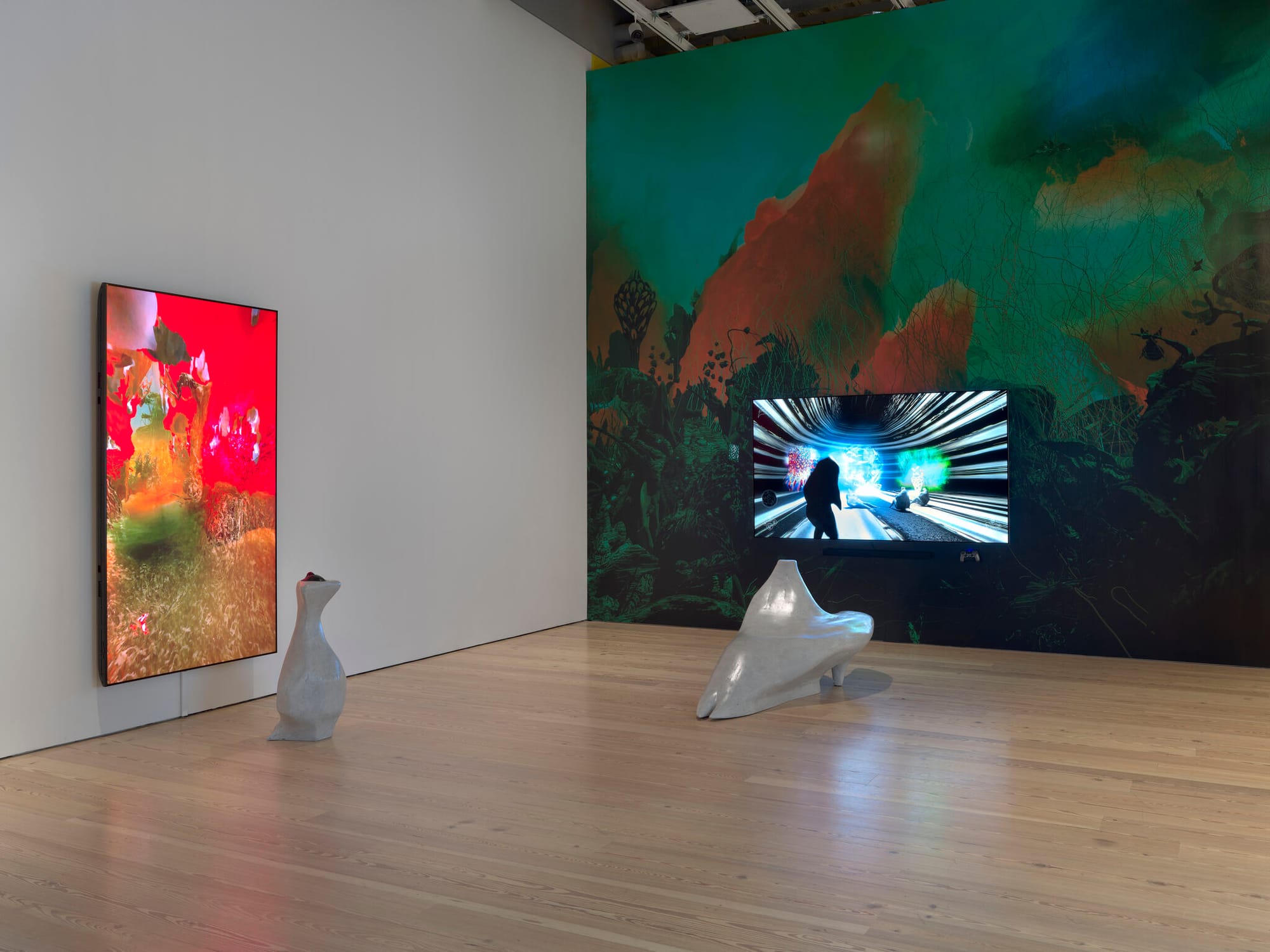
The installation offered several ways into the work. Visitors could play the main third-person adventure game, watch a 360-degree fly-through, or encounter a browser-based mini-game, Grotto, on the Whitney's Artport platform.
Castañeda hand-paints his textures, many of them derived from Negreiros's canvases. Unreal Engine offers a nearly endless supply of shortcuts ready-made trees, rocks, surfaces, lighting effects but Castañeda avoids much of it. He doesn't want the generic photorealism of a blockbuster game. The landscape is too specific for that.
It belongs partly to his grandmother's paintings, partly to the Amazon she remembers and partly to the strange ecology the two of them have built together. Inside it, the conventions of gaming start to shift. The landscape isn't the scenery behind the action. It watches you. It reacts to you. Treat it badly and it becomes hostile. Pay attention and something else becomes possible.
Castañeda spent part of the Biennial watching people work this out. One day at the Whitney, Castañeda was showing the exhibition to his mother and one of her friends when someone told him Hillary Clinton was walking by. He introduced himself and spent about a minute showing her his work. The encounter, he remembers, didn't make him particularly nervous.“I met Hillary Clinton and showed her my work for one minute, and I was okay with it,” he said.
His cousin was another matter. A hardcore gamer, he is, in Castañeda’s estimation, “the person that I know in the world that knows the most about gaming from a conceptual level.”
Knowing he was coming to see the exhibition made Castañeda nervous in a way meeting Clinton hadn't. “Gamers are way tougher than any art critic,” he said.
His cousin liked the game, but that didn't stop him from going straight to the problems. “This doesn’t work. This doesn’t work. This could be clearer.” Castañeda knew the criticism was useful. His reaction: “Phew. Okay. I have to start from scratch.”
The encounter points to one of the odd positions Castañeda occupies. Put a video game inside an art museum and two sets of expectations arrive with it. An art audience may be willing to spend time thinking about what a cloud or a sentient mountain means. A gamer wants to know whether the thing actually works.
At the Whitney, Castañeda saw both kinds of viewers, and many who didn't fit neatly into either category. Older visitors picked up the controller and struggled with the camera. Children seemed to understand it immediately. They moved through the landscape without needing much explanation. That difference fascinated him. One young girl spent some time with the work and then approached Castañeda with a sketchbook. She asked for his autograph.
He signed it. A few minutes later, the girl came back. Apparently, she had decided that the exchange wasn't quite fair. If he had given her his autograph, she ought to give him hers.
She handed him a small slip of paper. On it she had written, simply, "My autograph." Castañeda kept it. It is still tucked into his sketchbook. Of everything that came with exhibiting at the Whitney, the crowds, the attention, he calls the girl's autograph his most precious object.
Negreiros followed the Biennial from Cali, watching by video call as visitors moved through a world made partly from the paintings she had spent decades producing and partly from stories she had told her grandson from a hospital bed.
"Every time we talk about art, she'll say, 'It's one of the privileges of being alive,'" he said. "What I admire most about her is that she still has this childlike wonder for the discovery of artistic expression.”